TVIS, an explanation
- Teenage Kicks
-
Topic Author
- Offline
- Elite Member
-
- Toyota Fanboy
Less
More
- Posts: 889
- Thank you received: 0
19 years 3 months ago #14614
by Teenage Kicks
TVIS, an explanation was created by Teenage Kicks
What does it stand for?
T oyota V ariable I nduction S ystem.
What's it there for?
It is there to "allegedly" help improve engine output power, (torque), at low rpm.
How does it do that?
The car has 4 cylinders. Every cylinder is fed from the intake manifold. The intake manifold splits the air feed to each cylinder into 2. Therefore 4 cylinders with 2 air feeds to each cylinder equals 8 air feed "pipes" in the intake manifold.
It is a fact that if you alter the size/length/diameter of the pipes feeding the cylinders then you can increase the engines output at different rpm - it gets complicated but works on reflecting pressure waves, air velocity, some times referred to as the natural supercharging effect blah blah blah. Suffice to say that at different rpm then the inlet runners need to be a different size/length/diameter to produce the maximum output power.
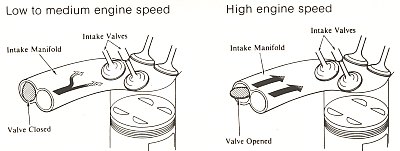
Toyota took advantage of this theory. The way Toyota have varied the inlet manifold to produce more power is by utilising 2 runners or "pipes" to each cylinder and blocking one off until you reach a certain engine speed - 4300rpm. Theoretically improving low rpm torque.
Inlet Manifold, Look Closely and you can see the Butterflies -
Diagram of the TVIS system, closed and open -
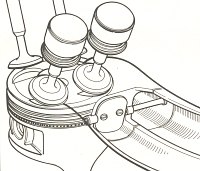
Another Diagram of the TVIS System Closed -
This system is only applicable to the ST165 and ST185

T oyota V ariable I nduction S ystem.
What's it there for?
It is there to "allegedly" help improve engine output power, (torque), at low rpm.
How does it do that?
The car has 4 cylinders. Every cylinder is fed from the intake manifold. The intake manifold splits the air feed to each cylinder into 2. Therefore 4 cylinders with 2 air feeds to each cylinder equals 8 air feed "pipes" in the intake manifold.
It is a fact that if you alter the size/length/diameter of the pipes feeding the cylinders then you can increase the engines output at different rpm - it gets complicated but works on reflecting pressure waves, air velocity, some times referred to as the natural supercharging effect blah blah blah. Suffice to say that at different rpm then the inlet runners need to be a different size/length/diameter to produce the maximum output power.
Toyota took advantage of this theory. The way Toyota have varied the inlet manifold to produce more power is by utilising 2 runners or "pipes" to each cylinder and blocking one off until you reach a certain engine speed - 4300rpm. Theoretically improving low rpm torque.
Inlet Manifold, Look Closely and you can see the Butterflies -
Diagram of the TVIS system, closed and open -
Another Diagram of the TVIS System Closed -
This system is only applicable to the ST165 and ST185
Please Log in to join the conversation.
19 years 3 months ago #14619
by Mr. G
JDM Isuzu Vehi-Cross....3.2l Quad Cam V6.....(Judge Dredd's Daily)
JDM Isuzu TFS 69 Crew Cab 3.1l Turbo.....(Work Horse)
UK Toyota Rav 4 (Shopping Trolley)
Non Jap....VX 220 Turbo Stage 2
Former Glories.....S14 200sx,R33 GTR......
Replied by Mr. G on topic Re: TVIS, an explanation
Good work Tony............if you were a Superhero you would be AUTO-STATISTIC-MAN................ ;D
JDM Isuzu Vehi-Cross....3.2l Quad Cam V6.....(Judge Dredd's Daily)
JDM Isuzu TFS 69 Crew Cab 3.1l Turbo.....(Work Horse)
UK Toyota Rav 4 (Shopping Trolley)
Non Jap....VX 220 Turbo Stage 2
Former Glories.....S14 200sx,R33 GTR......
Please Log in to join the conversation.
Time to create page: 0.078 seconds
- You are here:
-
Home
-
Forum
-
Technical
-
Manuals and General Info
- TVIS, an explanation